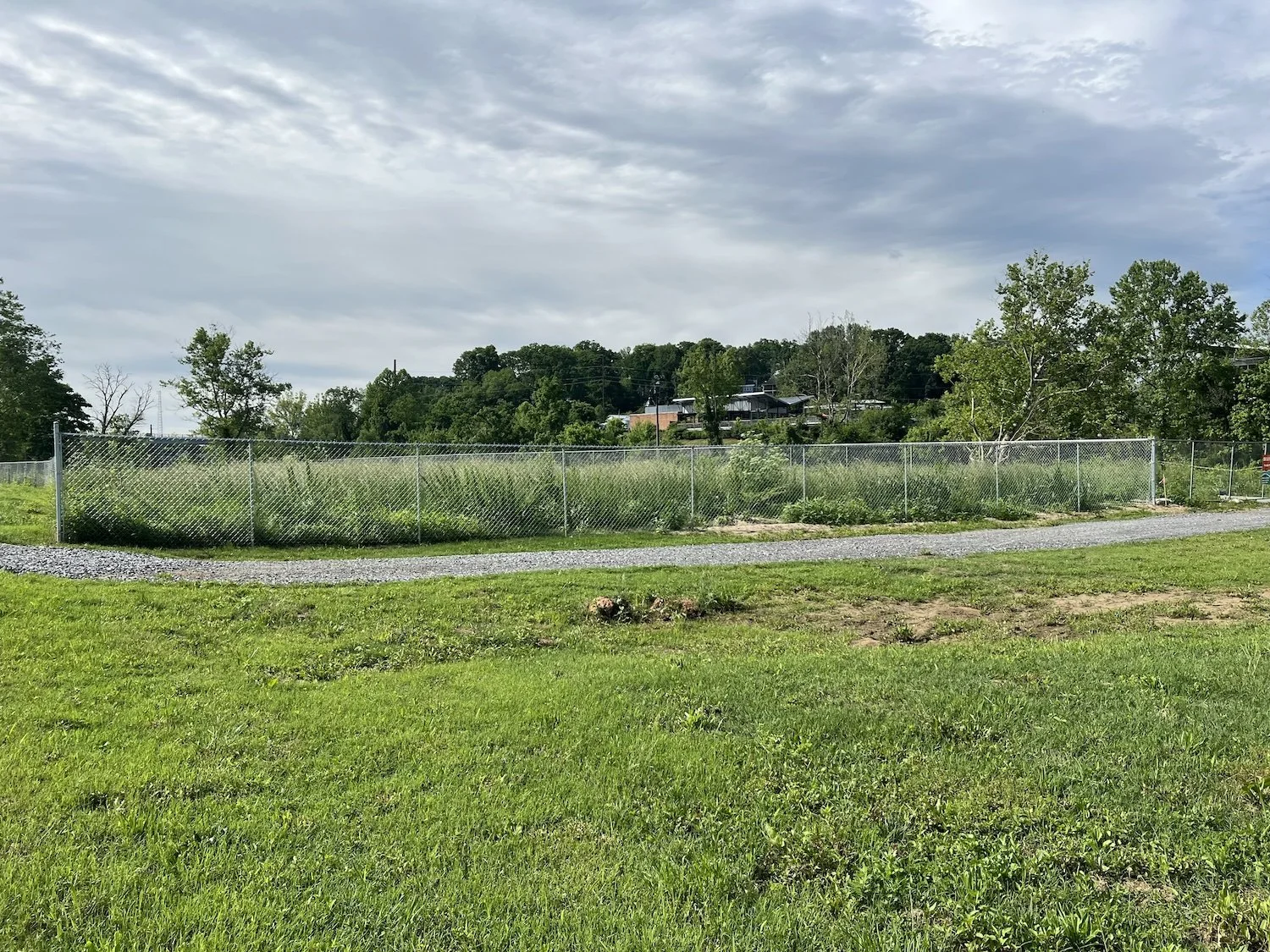
Installation site, pre-activation — May 18, 2025. Photo: Emily Clanton.
Project Background
The Ties That Bind Asheville was an artist-led participatory public art project conceived, developed, and authored by artist and researcher Emily Clanton.
Over 173 days (May 29 – November 7, 2025), the work invited people to tie strips of repurposed fabric onto a fence in Asheville's River Arts District, as well as onto modular forms used in temporary off-site activations.
Through this simple gesture, participants contributed wishes, memories, and reflections to a collective installation that evolved gradually through public presence and time.
PROJECT TIMELINE
May 2025
Initial activation
173 days
Duration
Nov 2025
Artist-led phase concluded.
Origins and Setting
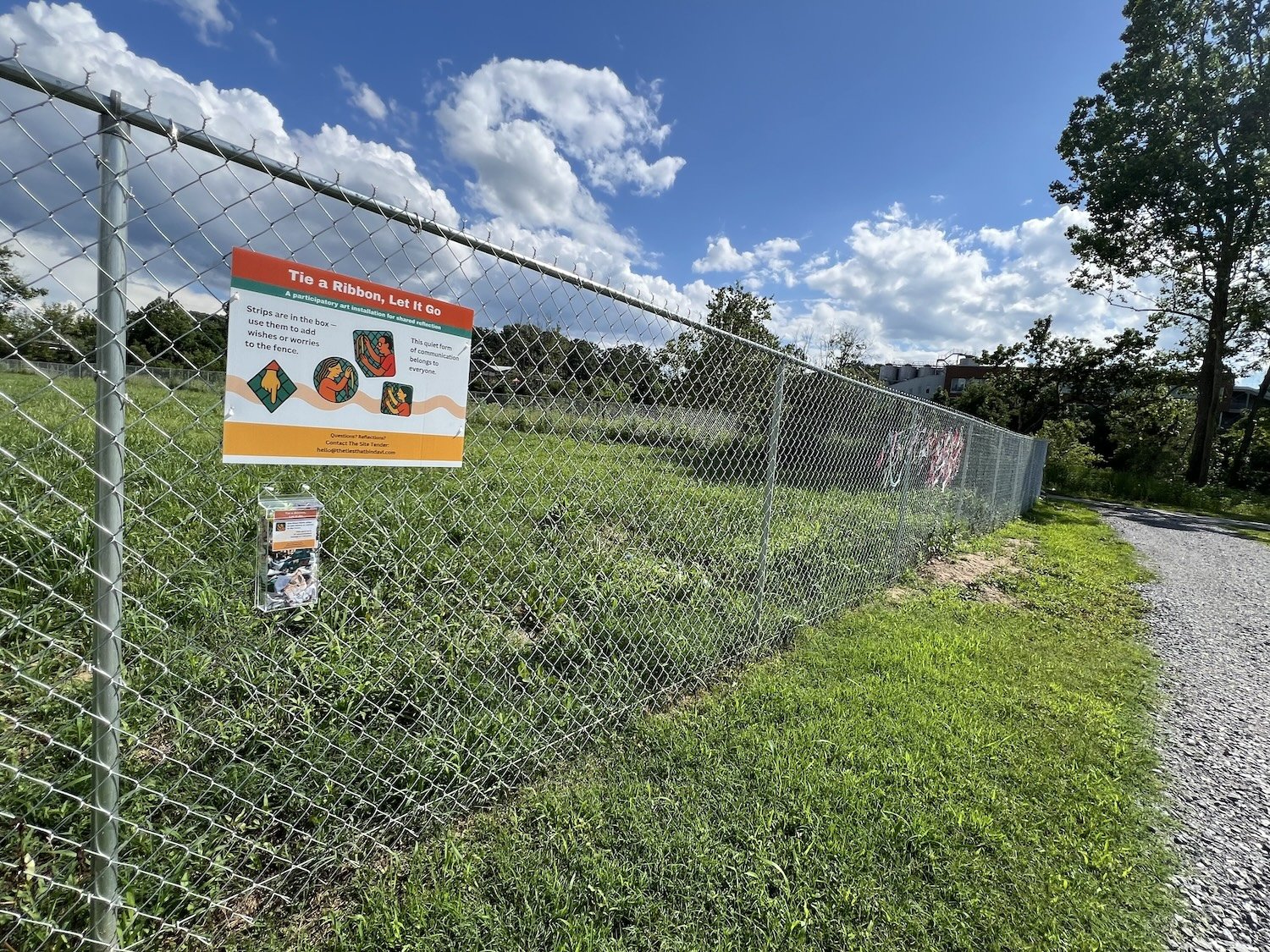
Initial activation with signage and materials — June 14, 2025. Photo: Emily Clanton.
The project first emerged during a community gathering held in May 2025 in an area still recovering from Tropical Storm Helene.
The event, organized by a local grief and renewal practitioner, created space for reflection and reconnection through symbolic and creative acts. Guided activities drew on nature, movement, and collective making to support shared healing.
Within this context, Clanton introduced a participatory artwork she had authored, inviting attendees to tie repurposed fabric strips onto a riverside fence as an initial activation.
Following the gathering, Clanton made the decision to return to the site on May 29 (Day 11) to carry the work forward as a sustained, artist-led installation.
This moment marked the transition from a single-event activation to a long-term public artwork rooted in civic space and open participation.
Project Arc (Condensed)
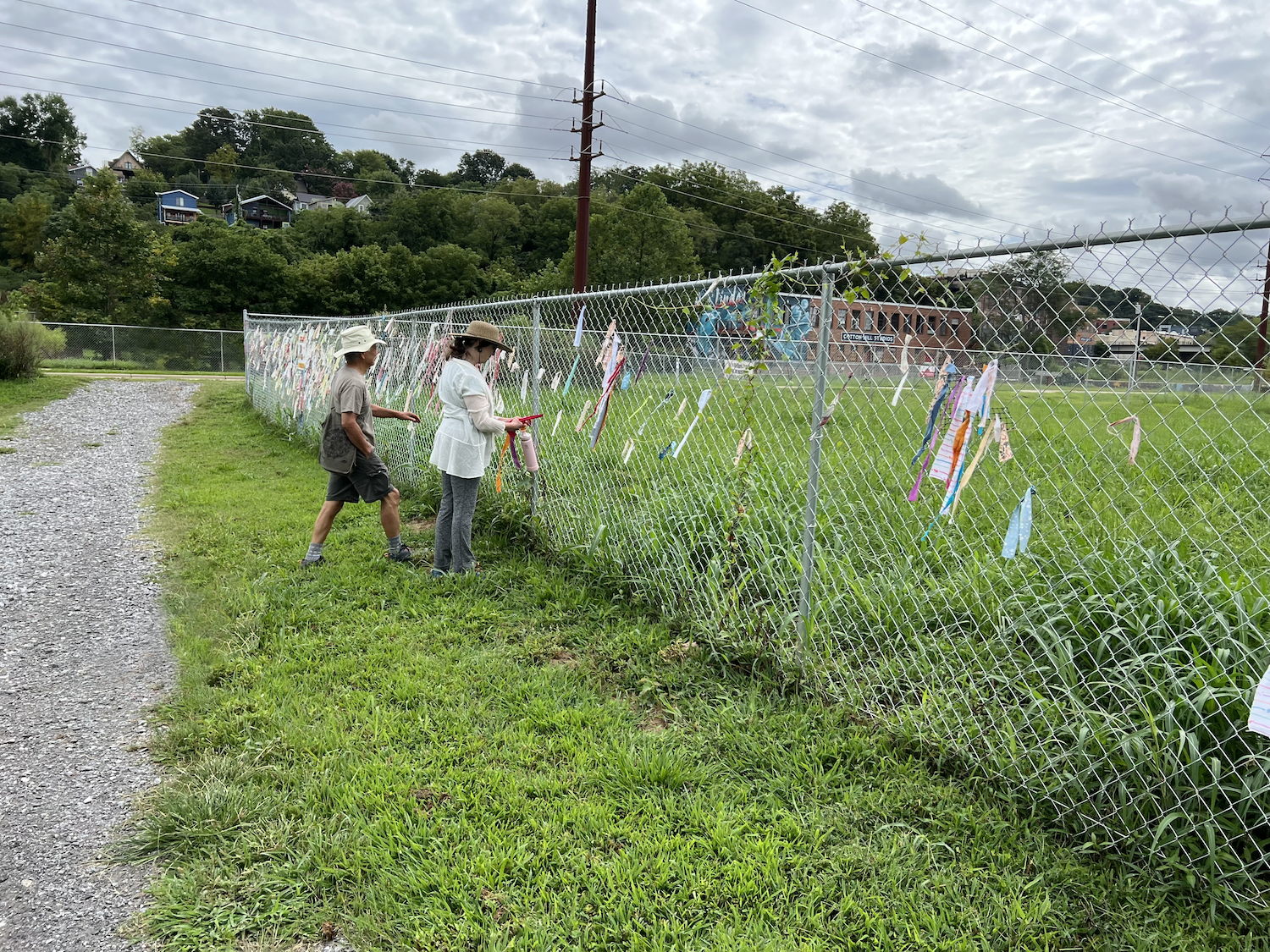
Public participation at the installation site — August 12, 2025. Photo: Emily Clanton.
The Ties That Bind Asheville unfolded over a clearly defined, artist-led arc that emphasized duration, presence, and care as core materials of the work.
The project began with an initial public activation on May 18, 2025, introducing the core participatory gesture within a community gathering context. On May 29, Clanton returned to the site to continue the work independently, marking the beginning of a sustained, artist-led installation rooted in civic space.
Over the following 173 days (May 29–November 7, 2025), the installation remained open to daily public participation.
As fabric strips accumulated, weathered, and shifted, the work evolved gradually through repeated acts of tying, tending, and documentation, forming a layered record shaped by time and collective presence.
During the summer months, the project expanded through modular and off-site activations in educational, cultural, and wellness settings. Materials gathered through these temporary extensions were later returned to the primary riverside installation, maintaining visual and symbolic continuity across sites.
The artist-led phase concluded on November 7, 2025. Portions of the installation were intentionally deinstalled and set aside for transformation into subsequent artworks, while much of the physical structure remained in place under community stewardship.
With the completion of this final phase, The Ties That Bind Asheville formally concluded as an artist-led project.
Development and Process
From its riverside beginnings, The Ties That Bind Asheville was intentionally developed into a modular, city-wide practice, expanding opportunities for creative participation in public space.
Fabric strips gathered from related activations were later returned to the primary fence site. Partner activations included:
Local Cloth
Warren Wilson College's Environmental Summit
Allon Health & Wellness
This circular process maintained both visual and symbolic continuity across locations, linking diverse environments and communities through a shared field of intention.
Through these iterative gestures, the project fostered ongoing dialogue about healing, labor, and connection in civic space. Each action, from preparing materials to tending the installation and documenting its changes,
Purpose
At its core, The Ties That Bind Asheville invited people to slow down, reflect, and participate in a collective act of presence.
Each tied strip represented an offering, a wish, a memory, or a moment of gratitude. Together, these individual contributions formed a record of participation shaped by time, weather, and touch.
The project was grounded in the idea that small, accessible creative gestures can strengthen social fabric and emotional resilience.
By meeting participants where they were in public spaces, educational settings, and wellness environments, Clanton designed the work to remain inclusive and accessible to a wide range of community members.
Acknowledgments and Documentation
The Ties That Bind Asheville was made possible through the generosity and engagement of community members and partner organizations who contributed materials, stories, and care.
With gratitude to:
Local Cloth
Warren Wilson College's Environmental Summit
Allon Health & Wellness
The many individual participants who helped sustain the installation throughout its 173-day duration
The public installation concluded on November 7, 2025 (Day 173). Over that period, visitors at the primary site and related activities transformed an ordinary fence into a living civic monument to connection.
Following its completion, the artist-led phase of The Ties That Bind Asheville formally concluded. The physical installation remains at the riverside site under community stewardship.
The artist-led phase of The Ties That Bind Asheville is complete.
Documentation Note
This account draws on project records, public event listings, and field documentation gathered between May and November 2025.
This website serves as the public record of The Ties That Bind Asheville as an artist-led project.
All text and images are presented for clarity, accessibility, and long-term reference.