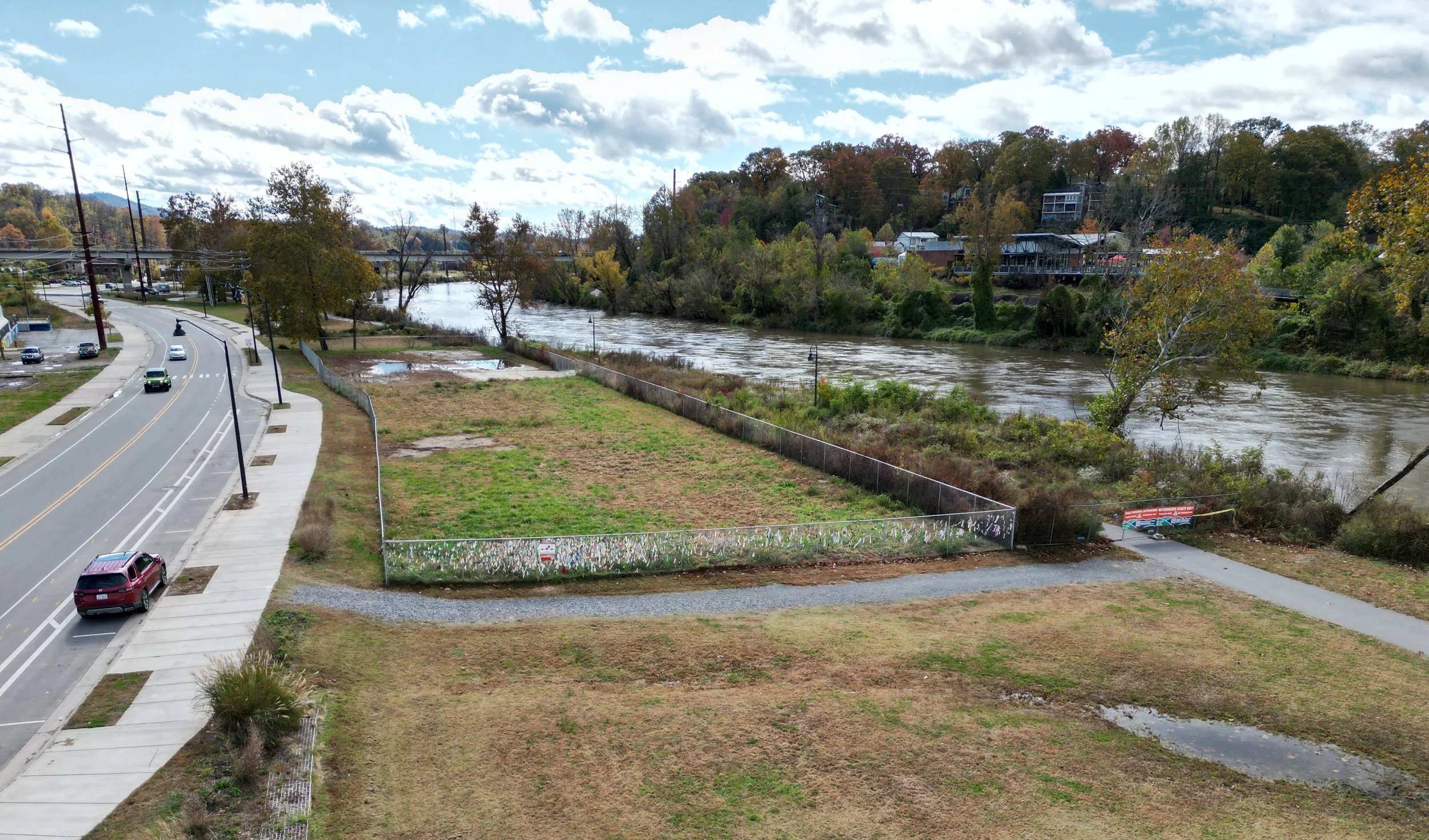
Aerial documentation of the installation site — October 30, 2025. Photo: Brett Clanton.
Credits & Provenance
Overview
The Ties That Bind Asheville is a participatory public art project developed and authored by Emily Clanton. The project brings together multiple forms of contribution—artistic authorship, community participation, stewardship, documentation, and research—each with distinct roles and responsibilities.
This page provides a record of provenance, credit, and conceptual context. It is intended to clarify how the work was created, how it has been supported, and how it is best understood over time.
Authorship
Artist and Project Author
Emily Clanton
Artist and Researcher
Emily Clanton is the creator and author of The Ties That Bind Asheville. She is responsible for the project's conceptual framework, artistic direction, ethical container, and long-term interpretation and documentation.
Authorship, in this context, refers to the artistic decisions, structural design, and ethical commitments that define the work. While community participation forms the installation's visible surface and emotional texture, the project's authorship remains with the artist.
Community Participation
Community members contributed to the installation by tying individual fabric strips as personal gestures. These contributions—carrying wishes, memories, and reflections—collectively shaped the work's evolving form during its active phase.
Community participation is essential to the meaning and experience of the installation. These contributions deepen the work without replacing or transferring artistic authorship.
Stewardship
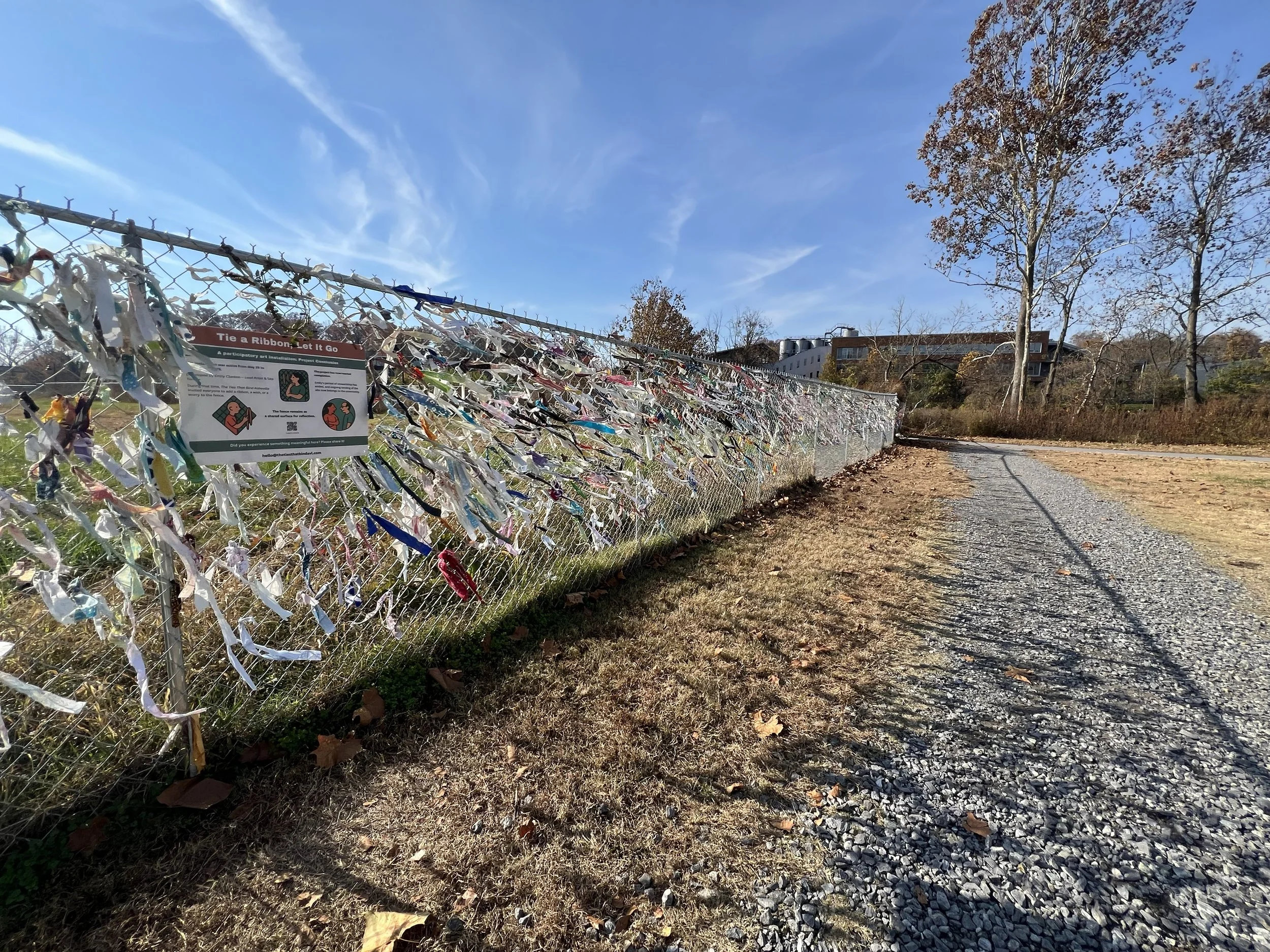
Final condition on closing day — November 7, 2025. Photo: Emily Clanton.
Following the conclusion of the artist-led phase on November 7, 2025, responsibility for the physical installation transitioned to community stewardship.
Community stewardship focuses on light, on-site care to ensure the installation remains safe, legible, and responsive to time and weather. Stewardship supports what already exists and does not include redesigning the work, altering its conceptual container, or shifting its artistic intent.
The artist's active stewardship and direct involvement concluded with the project's completion.
Collaborators and Project Support
The project has been supported by organizations and individuals who contributed space, materials, technical assistance, documentation access, and hosting support. These contributions are acknowledged with gratitude and respect and are clearly distinguished from artistic authorship.
Organizational Partners and Hosts
Local Cloth — project host; coordination support by Peggy Newell (Co-Chair, Special Events) and Judi Jetson (Chief Storyteller)
Warren Wilson College Environmental Summit — project host; invited and coordinated by Ryan Smolar, eco-civic connector
Allon Health & Wellness — project host; hosted by owner Nadja Simon
Website Development and Design
Sophia Robert — Web design, layout, and visual implementation
Editorial and Copy Support
Richard Gardener — Editorial collaboration and structural framing support
Onsite Documentation and Technical Support
Brett Clanton — construction assistance and aerial (drone) documentation
Amy Ortiz — closing-day photography
Documentation, Research, and Provenance Records
The Ties That Bind Asheville includes multiple layers of documentation and research developed to preserve the project's history, authorship, and ethical boundaries over time.
This knowledge structure and its underlying frameworks are authored by Emily Clanton and form part of an ongoing, versioned research-art system.
These materials include:
Core Concept & Process — Outlining the project's conceptual framework, ethical container, and participation design
Project Record & Provenance — Establishing authorship, chronology, responsibility, and decision-making authority
Selected Visual Lineage & Context — Situating the work within a broader visual, historical, and artistic context
Project documentation, provenance records, and related research materials are organized as a structured knowledge system to support attribution, provenance tracking, version control, and long-term stewardship of the work.
External Records and Knowledge Infrastructure
To support long-term attribution, discoverability, and responsible stewardship, The Ties That Bind Asheville is represented across several interconnected knowledge systems. Each serves a distinct role:
Wikibase Cloud (Project Knowledge Base)
Wikibase Cloud is a dedicated, artist-authored knowledge base that models the project's internal structure, authorship, methods, and provenance records. This system functions as the authoritative index for conceptual materials, documentation sets, and relationships between project components.
Zenodo (Archival Repositories)
Selected project records, documentation sets, and research materials are archived in Zenodo to provide stable, citable records with persistent identifiers (DOIs). Materials are organized across two Zenodo communities to reflect distinct documentation roles:
Zenodo Community: Core Concept & Process — includes archival records documenting the project's conceptual framework, participation design, ethical container, and authored process materials.
Zenodo Community: Project Record & Provenance — includes archival records preserving authorship, chronology, visual documentation, and contextual research associated with the project's implementation and reception.
These repositories preserve versioned snapshots of project materials and support long-term citation, institutional reference, and historical integrity.
Wikidata (Public Knowledge Graph)
Wikidata represents the project as a public reference point to support interoperability, discoverability, and alignment with external cultural and research.
Purpose of This Record
This Credits & Provenance page exists to ensure clarity, transparency, and respect for everyone involved in the project. By distinguishing authorship, participation, stewardship, and documentation, the project maintains a clear and ethical record as it moves forward in time.